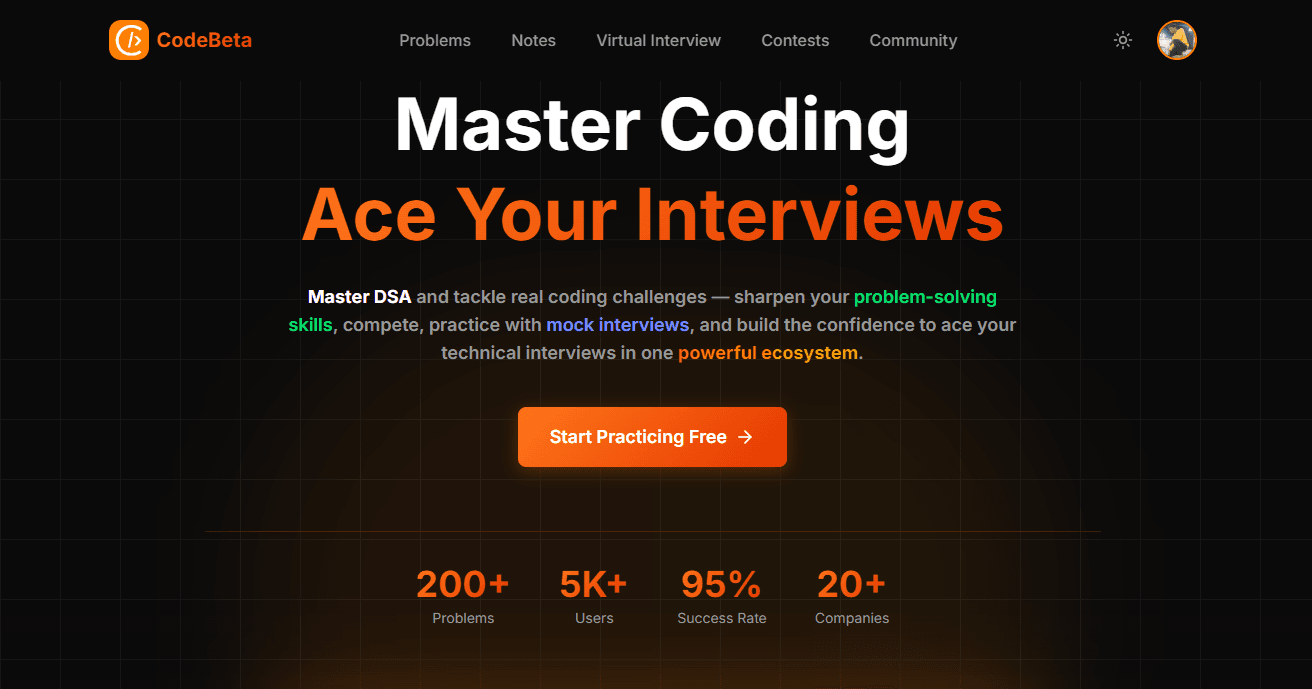
Master Coding - Ace Your Interviews
Master DSA and tackle real coding challenges — sharpen your problem-solving skills, compete, practice with mock interviews, and build the confidence to ace your technical interviews in one powerful ecosystem.
Problem Statement
"The Developer Journey Is Fragmented"
Aspiring software engineers struggle to prepare effectively for technical interviews because DSA practice, structured learning, competition, mock interviews, and interview readiness are fragmented across multiple platforms.
Developers move across different platforms for:
Practice • Learning • Notes • Discussions • Community • Mentorship • Contests • Interview Preparation
Even within coding practice, more problems do not always mean more progress.
Thousands of problems can leave learners asking:
“What should I solve next?”
The result can be:
Overwhelm → Inconsistency → Loss of Confidence
Developers have plenty of resources.
What they lack is a focused, connected journey from learning to interview readiness.
The Solution
"Meet CodeBeta — One ecosystem for the complete developer growth journey."
CodeBeta brings together everything developers need to learn, practice, improve, compete, and prepare for interviews — in one connected platform.
Learn → Practice → Discuss → Compete → Get Interview-Ready
What CodeBeta brings together
- Structured DSA Practice — Solve the right problems with focused learning paths.
- Learning & Notes — Learn concepts and build your own knowledge base.
- Discussions & Community — Learn from peers, share approaches, and grow together.
- Contests & Challenges — Test your skills under real-time competition.
- Mock Interviews — Practice real interview scenarios and build confidence.
- Progress & Growth — Turn consistent practice into measurable improvement.
From fragmented preparation to one focused journey.
Technology Stack
"Built for a Complete Coding Experience"
Frontend:
React.js powers the interactive user experience, while Tailwind CSS + DaisyUI provide a responsive, modern, and consistent interface.
Backend:
Node.js + Express.js handle APIs, authentication, business logic, submissions, contests, discussions, and platform operations.
Database:
PostgreSQL securely stores users, coding problems, submissions, progress, discussions, contests, and other platform data.
Code Execution:
Judge0 enables users to compile and execute code across multiple programming languages, evaluate test cases, and receive execution results.
Deployment & Infrastructure
"From Code to Production"
Frontend — Vercel
The CodeBeta frontend is deployed on Vercel, providing fast global delivery, automatic deployments, and seamless integration with the frontend codebase.
Backend — Linode
The backend is hosted on a Linode cloud server, giving CodeBeta control over its backend infrastructure, APIs, and server resources.
Containerization — Docker
Docker is used to containerize backend services and dependencies, making the application easier to deploy, manage, and maintain consistently across environments.
Reverse Proxy & HTTPS — Nginx
Nginx sits in front of the backend services and handles reverse proxying, routing incoming requests to the appropriate application service. It also helps manage HTTPS/SSL, security, and web traffic.
Vercel powers the frontend, while Linode, Docker, and Nginx provide a controlled, scalable, and secure backend infrastructure.
The CodeBeta Story
"It Wasn't Just Built. It Was Fought For."
Every product has a beginning.
CodeBeta started with a simple thought:
What if developers had one focused place to learn, practice, compete, collaborate, and prepare for interviews?
At first, it was just an idea.
Then came the planning.
Then the code.
Then the bugs.
Then the sleepless nights.
Then the servers.
Then the deployment.
Then the unexpected disasters.
And somewhere along the way, I realized something:
I wasn't just building CodeBeta. CodeBeta was building me.
Chapter 01 — The Idea
"Where CodeBeta began."
Before writing code, I had to answer a simple question:
What exactly are we trying to solve?
The developer journey felt fragmented.
Developers were jumping between different platforms to learn, practice DSA, take notes, discuss problems, participate in contests, build communities, and prepare for interviews.
And even when there were thousands of coding problems available, another problem appeared:
“What should I solve next?”
I wanted to build something more focused.
Something that could connect different stages of the developer journey.
And that's where the idea of CodeBeta began.
It wasn't supposed to be just another coding platform.
The goal was bigger:
Create a connected ecosystem for developer growth.
Chapter 02 — Building the Foundation
"Turning an idea into architecture."
Before the first serious line of code, I spent the first two weeks planning.
Requirement gathering.
Feature planning.
User journeys.
Frontend wireframes.
UI/UX planning.
Database design.
Backend architecture.
API planning.
Code execution architecture.
I tried to think through the entire product before building it.
What happens when a user signs up?
How does authentication work?
How does a problem get created?
How are test cases stored?
What happens when someone submits code?
How does the code reach the execution engine?
How is the result returned?
How is the submission stored?
How does everything connect?
The wireframes started giving the idea a visual identity.
The database started giving it structure.
The backend architecture started giving it a brain.
The idea was slowly becoming a product.
Chapter 03 — Building the Engine
"The moment CodeBeta started coming alive."
With the foundation ready, I started building the backend.
Project setup.
Database integration.
Authentication.
JWT.
Protected routes.
User management.
API architecture.
Then came the core platform functionality.
Problems.
Submissions.
Discussions.
Contests.
Progress.
User data.
Business logic.
Everything that the frontend would eventually depend on had to be built.
There was nothing glamorous about this stage.
Most of the time it was just:
VS Code + Terminal + Postman + Database + Errors.
And, of course...
“Why is this API returning 500?”
😂
But slowly, API by API, CodeBeta's backend started taking shape.
The engine was being built.
Chapter 04 — The First Big Fight
"Three days. One problem. Almost no hope."
Every project has that one problem that makes you question your life decisions.
For CodeBeta...
that problem was Judge0.
CodeBeta needed a code execution system so users could submit programs and receive actual execution results.
I decided to use Judge0.
The plan sounded simple:
Set it up locally → connect it with the backend → execute code.
Reality had other plans.
I tried setting up Judge0 locally.
It didn't work.
I tried again.
Still didn't work.
I searched.
I changed configurations.
I tried different approaches.
Still nothing.
One day passed.
Then another.
Then another.
Three days.
At that point, I wasn't sure whether I was building CodeBeta or whether Judge0 was building my patience. 😭
Eventually, I reached that stage every developer knows:
“Bas bhai... ab nahi ho raha.”
I had almost given up.
But instead of stopping, I reached out to fellow learners on Discord.
And that's where something really important happened.
People I didn't even know personally took the time to help.
They shared solutions.
They explained configurations.
They suggested things I hadn't tried.
And finally...
Judge0 was running.
That moment taught me something that stayed with me:
You don't have to know everything. Sometimes you just need to know who to ask.
Chapter 05 — Breaking What We Built
"Testing every piece before putting it together."
The backend APIs were ready.
Judge0 was finally working.
Now it was time to test the entire coding workflow.
I moved to Postman.
And that's when I discovered how much work goes into something that looks simple to a user.
Creating a problem.
Adding test cases.
Submitting code.
Executing it.
Checking the output.
Handling errors.
Storing the submission.
Testing different scenarios.
Testing again.
And again.
Adding even a single problem and properly testing its execution flow took significant effort.
It wasn't:
“Add problem → Done.”
It was:
“Add problem → Add test cases → Execute → Check → Debug → Fix → Execute again → Break something else → Fix that → Repeat.”
😂
By the time the whole workflow started feeling reliable...
the next phase was waiting.
Chapter 06 — The Unexpected Detour
"Sometimes the journey doesn't go according to plan."
Now it was time to build the frontend.
The wireframes were ready.
The APIs were ready.
The architecture was ready.
But life had another plan.
I got a freelance client.
And honestly, I needed the opportunity.
So CodeBeta went on pause.
Not abandoned.
Just paused.
For almost three months, I worked on the freelance project.
Client requirements.
Changes.
Deadlines.
Revisions.
Delivery.
The usual freelance life.
Meanwhile, CodeBeta was sitting there.
Waiting.
After completing the freelance project, I had a decision to make.
Continue with something else?
Or return to the unfinished product?
I chose CodeBeta.
Chapter 07 — The Comeback
"Three months later, CodeBeta was waiting."
Coming back to the project after a long break felt strange.
The code was still there.
The wireframes were still there.
The idea was still there.
But now I had to finish what I started.
So I went all in.
I started building the frontend.
Page by page.
Component by component.
Feature by feature.
The dashboard.
Problem pages.
Coding environment.
Discussions.
Profiles.
Navigation.
Different user flows.
Everything.
This time, I worked intensely every day.
The project started transforming from backend APIs and wireframes into something that actually looked like a product.
After almost four weeks...
the frontend was ready.
And for the first time, CodeBeta actually looked like the thing I had imagined months earlier.
Chapter 08 — Does It Actually Work?
"Connecting everything. Testing everything."
Now came the moment of truth.
It looked good.
But did it actually work?
I tested everything.
Signup.
Login.
Authentication.
Problem creation.
Problem solving.
Code execution.
Submissions.
Discussions.
User flows.
Frontend to backend.
Backend to database.
Backend to Judge0.
And then...
something broke.
Fix it.
Test again.
Something else broke.
Fix that.
Test again.
Classic software development. 😅
Eventually, the major flows started working together.
And then came the next question:
“Okay... where do we deploy this?”
Chapter 09 — From Localhost to the World
"The moment CodeBeta left my laptop."
Until now, most of the problems were happening inside my development environment.
Now I had to put CodeBeta on the internet.
I chose Linode for the backend infrastructure.
And suddenly, I entered a completely different world.
Linux.
SSH.
Firewall.
DNS.
Nginx.
HTTPS.
SSL.
Docker.
Environment variables.
Ports.
Reverse proxy.
Security.
I realized something:
Building an application and running an application are two very different things.
The deployment phase forced me to learn things I hadn't initially planned to learn.
And that was actually one of the most valuable parts of the journey.
Chapter 10 — Welcome to the Real World
"Nobody tells you how much work happens after “it works on my machine.”"
Once the application was ready to deploy, another question appeared:
“Is this actually secure?”
That question opened another rabbit hole.
I started learning about:
Rate limiting.
CORS.
Security headers.
Input validation.
Authentication security.
Firewall configuration.
HTTPS.
Reverse proxies.
Server hardening.
I spent hours reading documentation, articles, watching videos, searching Google, asking ChatGPT, and trying things directly on the server.
Sometimes something worked.
Sometimes it didn't.
Sometimes I had absolutely no idea what I had just broken.
😂
But eventually...
The server was configured.
The application was deployed.
DNS was connected.
Nginx was configured.
HTTPS was working.
The frontend was connected to the backend.
And then...
CodeBeta was live.
Chapter 11 — Launch Day
"After months of building, CodeBeta finally went public."
The machine was ready.
The server was ready.
The application was ready.
The domain was ready.
Everything was connected.
I opened the browser.
Entered the domain.
Pressed Enter.
And there it was.
CodeBeta Was Live.
After months of development.
After the Judge0 nightmare.
After the freelance detour.
After rebuilding the frontend.
After deployment.
After security configuration.
After countless bugs.
After countless searches.
After all the frustration...
the product was finally accessible to the world.
That feeling was difficult to explain.
It was one of those moments where you just sit there quietly and think:
“Damn... I actually built this.”
But then...
the movie wasn't over.
Chapter 12 — The Final Boss: SMTP
"The website was live. Signup wasn't."
There was one small but extremely important part of CodeBeta:
Email OTP verification.
User signs up.
OTP is generated.
OTP goes to email.
User verifies it.
Account gets created.
Simple.
Except...
the email wasn't going out.
😐
I started debugging.
Application?
Fine.
Authentication?
Fine.
SMTP configuration?
Looks fine.
Then I discovered the real problem:
Linode had blocked the SMTP ports.
So I opened an issue.
Waited.
No solution.
I emailed them.
Waited again.
Still no solution.
At this point I was thinking:
“Website launch kar diya... users ko andar aane ka gate hi band hai.” 😭
So I called Linode.
After explaining the problem and going through the troubleshooting process...
the issue was finally resolved.
The SMTP connection started working.
OTP arrived.
Signup worked.
And suddenly, that tiny email verification message felt like a massive victory.
Chapter 13 — One More Disaster After Launch
"We thought the hard part was over."
The site was live.
Signup was working.
The application was running.
Users could access it.
And then I noticed something strange.
CodeBeta was working perfectly on most networks...
except Airtel.
At first, I thought:
“Maybe it's an Airtel network issue.”
Maybe it would disappear after some time.
So I waited.
But the problem stayed.
And that's when the real investigation began.
I contacted the Airtel team.
They asked for documentation.
Proof of domain ownership.
Security-related information.
Details about the website.
I provided everything they requested.
But then we discovered something much bigger.
Chapter 14 — The Blacklist Discovery
"One ISP problem turned into a much bigger investigation."
While investigating the Airtel blocking issue, I checked the domain through VirusTotal.
And there it was.
The thing I wasn't expecting.
Multiple security vendors had flagged the domain.
At one point, around 17 vendors were blocking or flagging CodeBeta.
That was a difficult moment.
Imagine spending months building something.
Deploying it.
Launching it.
Finally seeing users arrive...
And then discovering:
“Wait... some security systems think my website is dangerous?”
It was frustrating.
It was confusing.
And honestly...
a little heartbreaking.
Because I knew what CodeBeta was.
I knew what we had built.
But automated security systems didn't know our story.
They only saw a domain with a reputation problem.
Chapter 15 — The Whitelist Campaign
"If they didn't know our story, we had to tell it."
So I started contacting the security vendors.
One by one.
Vendor after vendor.
I submitted false-positive reports.
I provided domain information.
I explained what CodeBeta was.
I explained the purpose of the platform.
I provided the required details.
And then came the waiting.
Some responded quickly.
Some took time.
Some required additional information.
Some changed their classification.
Slowly...
the numbers started coming down.
Vendor by vendor.
Flag by flag.
One after another...
most of them whitelisted CodeBeta.
At the beginning, around 17 vendors were flagging the domain.
After submitting the reports and working through the process, almost all of them cleared the domain.
A few vendors still haven't cleared it yet.
But I'm still working on it.
And honestly?
I believe they'll eventually clear it too.
Because this time, I'm not just waiting for the problem to disappear.
I'm actively fighting it.
Chapter 16 — The Number That Made It All Worth It
"500+ users in the first week."
And then came the moment that changed the mood completely.
Despite the Airtel accessibility problem...
Despite the security vendors...
Despite having no massive marketing campaign...
Despite having no huge team behind us...
500+ users became active on CodeBeta in the first week.
I opened the analytics.
Looked at the numbers.
And for a moment...
I just smiled.
Because I remembered everything that had happened before that screen.
The wireframes.
The backend.
The APIs.
The Judge0 problem.
Those three frustrating days.
The Discord help.
Postman.
The freelance detour.
Coming back.
Four weeks of frontend development.
The server.
Linux.
Nginx.
Docker.
Security.
Deployment.
SMTP.
Calling Linode.
Airtel.
VirusTotal.
17 security vendors.
All those emails.
All those problems.
And now...
500+ real users were actually using something I built.
That feeling is difficult to put into words.
Because analytics isn't just a number anymore.
For me, it represents:
“Someone out there actually found this useful.”
And that is probably one of the best feelings a builder can experience.
Chapter 17 — What CodeBeta Built in Me
"The product wasn't the only thing that grew."
When I started CodeBeta, I thought I was building a coding platform.
But along the way, I learned much more than coding.
I learned backend development.
I learned system architecture.
I learned databases.
I learned code execution systems.
I learned testing.
I learned Linux.
I learned networking.
I learned deployment.
I learned security.
I learned debugging.
I learned how to ask for help.
I learned how to deal with failure.
And most importantly...
I learned that building a real product is completely different from building a project.
A project teaches you how to write code.
A product teaches you how to deal with everything that happens after the code works.
Chapter 18 — This Is Just the Beginning
CodeBeta is live.
But I don't see this as the finish line.
I see it as Day 1.
There are still problems to solve.
Features to build.
Users to listen to.
Bugs to fix.
Security systems to deal with.
Ideas to test.
And an entire developer ecosystem to build.
Because the original belief hasn't changed.
The journey to becoming a great software engineer shouldn't be fragmented.
It should be:
Focused.
Collaborative.
Accessible.
And connected.
From:
Learning → Practicing → Improving → Competing → Interviewing → Getting Hired
That's why CodeBeta exists.
And after everything we've been through...
I know one thing for sure:
The story isn't ending here.
This is just the beginning.
Final Verdict
We didn't build CodeBeta to create just another platform where developers solve coding problems.
We built CodeBeta because we believe the journey to becoming a great software engineer should be more focused, more structured, more collaborative, and more accessible.
A journey where you know what to learn, what to practice, how to improve, and how to prepare for the real world.
And this is just the beginning.
Welcome to CodeBeta.
"Learn. Practice. Collaborate. Compete. Get Hired."