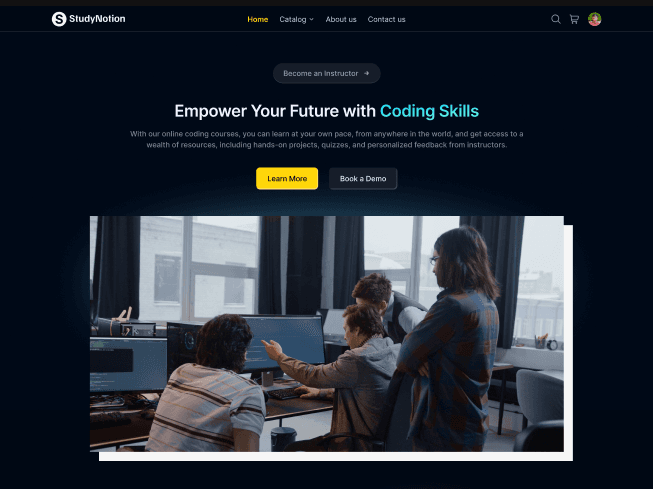
"Empower Your Future with Coding Skills"
StudyNotion was built to democratize education. The platform empowers instructors to easily create courses and students to consume them seamlessly. I implemented a robust backend to handle video content and integrated Razorpay to ensure smooth financial transactions.
Problem Statement
"Education Shouldn't Be Limited by a Classroom."
Learning is changing, but access to quality education is still fragmented.
Students often struggle to find accessible, engaging, and structured learning experiences that fit their pace, goals, and learning style.
At the same time, educators face challenges in creating, managing, and monetizing courses while reaching learners beyond the boundaries of a physical classroom.
This creates a gap:
Learners need better ways to learn.
Educators need better ways to teach.
The Challenge
- 📚 Limited Accessibility — Quality learning shouldn't depend on location, time, or physical classrooms.
- 🎯 Disconnected Learning — Students need structured courses and content they can consume at their own pace.
- 👨🏫 Limited Reach for Educators — Instructors need a platform to create and share their knowledge with a wider audience.
- 💳 Complex Course Monetization — Educators need a simple and reliable way to sell courses and receive payments.
The Solution
"Meet StudyNotion — A complete platform where educators create, students learn, and knowledge moves freely."
StudyNotion connects Instructors and Students in one seamless ecosystem—making it easier to create, discover, purchase, consume, and engage with educational content.
Create → Publish → Discover → Learn → Review → Grow
- Instructor Platform — Create, publish, and manage courses with dedicated analytics dashboards.
- Student Experience — Discover and purchase courses, stream educational content, and learn at their own pace.
- Role-Based Access — Secure, role-specific experiences for Students and Instructors, with email verification during registration.
- Course Engagement — Students can rate and review courses, creating valuable feedback for instructors.
- Secure Payments — Razorpay integration enables seamless and secure course purchases.
- Account Management — Includes secure authentication, Forgot Password, and profile editing functionality.
- Responsive Design — A clean, responsive interface delivers a consistent experience across devices.
StudyNotion turns online education into a connected ecosystem where educators can share knowledge and learners can discover, access, and grow from it.
Technology Stack
"A modern MERN-based architecture"
Frontend:
React.js powers the dynamic and interactive user interface, while JavaScript handles the application logic and user interactions. Tailwind CSS is used to build a clean, responsive, and modern UI across different screen sizes.
Backend:
Node.js powers the backend and handles APIs, authentication, course management, user operations, reviews, and business logic.
Database:
MongoDB stores and manages application data including users, courses, course content, enrollments, reviews, and other platform information.
Payments:
Razorpay is integrated to enable secure online payments, allowing students to purchase courses through a seamless checkout experience.
A modern MERN-based architecture with Razorpay integration, designed to deliver a seamless and scalable online learning experience.
Deployment & Infrastructure
"From Localhost to the Web"
Frontend — Vercel
The StudyNotion frontend is deployed on Vercel, providing fast and reliable content delivery with automatic deployments whenever new changes are pushed to the project repository. It ensures the React application is easily accessible across devices.
Backend — Render
The backend is deployed on Render, which hosts the Node.js server and provides the APIs required for authentication, course management, user operations, reviews, and payment processing.
Vercel powers the user-facing experience, while Render hosts the backend APIs, creating a simple and reliable deployment architecture for the platform.
The StudyNotion Story
"The project that taught me how to become a developer."
Every developer has that one project that is more than just a project.
For me, that project was StudyNotion.
It started when I was doing my BCA and was learning full-stack development through online courses and YouTube.
At that time, I was learning everything for the first time:
Frontend.
Backend.
Databases.
APIs.
Authentication.
Deployment.
I was learning the concepts...
But understanding a concept and actually building something with it are two completely different things.
And StudyNotion became the place where I learned that difference.
🎬 CHAPTER 01 — THE BEGINNING
"A student, a course, and an ambitious project."
During my BCA, I started learning full-stack development through courses and YouTube tutorials.
I learned how frontend applications work.
I learned React.
I learned how servers work.
I learned Node.js and Express.
I learned databases.
I learned authentication.
I learned how APIs are supposed to work.
And eventually, I thought:
“Okay... now let's build something.”
That's when StudyNotion started.
The idea was an EdTech platform where:
Instructors could create courses.
Students could discover and consume them.
Students could purchase courses.
Users could rate and review educational content.
It sounded exciting.
I had learned all the technologies.
So naturally, I thought:
“How hard could it be?”
😂
I was about to find out.
🧩 CHAPTER 02 — FROM TUTORIALS TO REAL CODE
"Knowing the syntax wasn't the same as knowing how to build."
I started by designing the application.
I thought about the frontend.
I thought about the backend.
I thought about the database.
I tried to design the overall architecture.
But there was one small problem...
I was still very new.
I knew what an API was.
But I didn't really know how to design a complete API system.
I knew MongoDB.
But designing a database for an actual application was different from watching someone do it in a tutorial.
I knew React.
But connecting an entire frontend to a real backend with authentication, protected routes, course management, payments, and user roles was a completely different experience.
And then there was testing.
“How do I actually test this API?”
I knew Postman existed.
But knowing Postman exists and knowing how to properly test an application are two different things.
So I learned.
Then forgot.
Then tried again.
Sometimes I understood something.
Sometimes I understood absolutely nothing.
Sometimes I would stare at an error for an hour and think:
“What exactly is this computer trying to tell me?”
😂
🔄 CHAPTER 03 — STOP. START. STOP. START.
"The project wasn't built in one straight line."
One of the most honest parts of this story is this:
I didn't build StudyNotion continuously.
I would work on it.
Get stuck.
Feel frustrated.
Stop.
Take some time away.
Learn something else.
Come back.
Try again.
Get stuck again.
And repeat.
There were moments when I thought:
“Maybe I'm not ready to build this yet.”
But after some time, I would open the project again.
Look at the code.
Try something new.
And continue.
Slowly...
The backend started coming together.
Then the frontend.
Then authentication.
Then course functionality.
Then database operations.
Then different user roles.
Then payments.
Then reviews.
Feature by feature...
StudyNotion started becoming real.
🐛 CHAPTER 04 — THE BUGS WERE MY REAL TEACHERS
"Every error had something to teach me."
StudyNotion came with a lot of bugs.
And I mean...
A LOT.
😂
Something would work on one page but break on another.
An API wouldn't return what I expected.
The database wouldn't behave the way I thought it would.
Authentication would fail.
Frontend and backend wouldn't communicate correctly.
Something would work in development and then behave differently somewhere else.
And every time something broke, I had to investigate.
Search.
Read.
Try.
Fail.
Try again.
Debug.
Fix.
Test.
Break something else.
Fix that too.
At the time, it was frustrating.
But looking back...
those bugs were probably my best teachers.
Because tutorials taught me:
“This is how you build it.”
The bugs taught me:
“This is why it actually works.”
And that difference was huge.
🧠 CHAPTER 05 — THE LONG LEARNING CURVE
"From copying concepts to actually understanding them."
There were many times when I was following a course and could understand what the instructor was doing.
But when I tried to implement the same thing myself...
my brain suddenly said: “Good luck.” 😭
That was one of the biggest challenges.
Following along is comfortable.
Building independently is not.
I had to stop depending completely on tutorials and start figuring things out myself.
Why is this API designed this way?
Why do we need this middleware?
Why is this data stored like this?
Why isn't my request reaching the backend?
Why is this authentication failing?
Why is this database query returning nothing?
These questions forced me to understand the technology instead of just remembering the syntax.
And slowly...
I started becoming less dependent on the tutorial.
🎨 CHAPTER 06 — FROM BACKEND TO FRONTEND
"Bringing the application to life."
Eventually, the backend started working.
Now it was time to bring the application to life.
I started building the frontend.
Pages.
Components.
Navigation.
Authentication screens.
Course pages.
Dashboards.
Instructor functionality.
Student functionality.
Course consumption.
Reviews.
And the connection between frontend and backend.
For the first time, I could actually see what I had been building.
It wasn't just API responses anymore.
It was becoming an actual product.
And that feeling was exciting.
Because there is something special about seeing:
“This thing that existed only in my head is now running in a browser.”
💳 CHAPTER 07 — MAKING IT FEEL LIKE A REAL PRODUCT
"Integrating payments and real user flows."
Then came another major piece:
Payments.
I integrated Razorpay so students could purchase courses.
Now the application had to deal with something more serious than just displaying data.
There were payments.
Transactions.
Verification.
Course access.
User state.
Security considerations.
And more things that could go wrong. 😅
But getting the complete flow working was another major milestone.
A student could discover a course → purchase it → complete the payment → and access the course.
At that point, StudyNotion was no longer just a learning project.
It was starting to feel like a real application.
🚨 CHAPTER 08 — DEPLOYMENT: THE REAL FINAL BOSS
"“It works on my laptop.”"
There is a sentence every beginner developer eventually learns to fear:
“It works on my machine.”
😂
StudyNotion worked locally.
So naturally, the next step was:
Deploy it.
And that's where my confidence disappeared again.
Because I had another problem.
I didn't really know Git properly.
I knew Git existed.
I knew GitHub existed.
But using Git effectively and preparing a project for real deployment was another story.
Then came:
Vercel.
Render.
Environment variables.
Build commands.
Production configuration.
Frontend deployment.
Backend deployment.
Connecting frontend to backend.
Database configuration.
CORS.
And then...
errors.
💥 CHAPTER 09 — THE DEPLOYMENT DISASTER
"Everything worked locally. Production had other plans."
I deployed.
Error.
Changed something.
Tried again.
Another error.
Fixed that.
Another problem appeared.
At some point I was thinking:
“Localhost pe sab mast chal raha tha... production ko kya problem hai?” 😭
I spent a lot of time trying to understand what was happening.
I searched Google.
Watched videos.
Read articles.
Went back to the course.
Looked at documentation.
Tried different configurations.
Pushed changes.
Deployed again.
Failed again.
Fixed again.
Repeat.
It was frustrating.
And honestly, there were moments when I felt really sad and disappointed.
Because after spending so much time building the application, I couldn't even get it properly online.
But I kept going.
🌐 CHAPTER 10 — FROM LOCALHOST TO LIVE
"The moment everything finally clicked."
After a lot of trial and error, I started understanding deployment.
Git started making more sense.
GitHub started making more sense.
Vercel started making more sense.
Render started making more sense.
Environment variables.
Production builds.
API URLs.
Frontend-backend communication.
Database connections.
One by one, the pieces started falling into place.
And then...
it happened.
I opened the deployment link.
The application loaded.
The frontend was live.
The backend was responding.
The database was connected.
The application was actually running on the internet.
I just stared at the screen for a moment.
Because I knew what that link represented.
It wasn't just a URL.
It represented months of confusion.
Hundreds of bugs.
Countless searches.
Repeated failures.
And a lot of learning.
🎓 CHAPTER 11 — THE TIMING COULDN'T HAVE BEEN BETTER
"A poetic ending to a long journey."
And there was something special about that moment.
I had finally deployed StudyNotion...
and around the same time, I was finishing my BCA.
So there was something poetic about it.
I started the project as a student who was still figuring out what an API actually meant.
And I finished it as a graduate who had actually built and deployed a full-stack application.
I started with:
“I don't know how to build this.”
And ended with:
“I built it.”
That transformation was bigger than the application itself.
❤️ CHAPTER 12 — WHAT STUDYNOTION TAUGHT ME
"Learning the things tutorials skip."
StudyNotion wasn't my most advanced project.
It wasn't perfect.
And I definitely didn't know everything when I started.
But that's exactly why it was so important.
It taught me what tutorials couldn't.
It taught me how to:
- Design a real application architecture.
- Build and connect APIs.
- Work with databases.
- Implement authentication.
- Handle different user roles.
- Integrate payments.
- Debug real-world problems.
- Use Git and GitHub.
- Deploy frontend and backend applications.
- Work with production environment variables.
- Troubleshoot deployment failures.
- Keep going when I didn't know the answer.
Most importantly, it taught me how to learn by building.
🚀 CHAPTER 13 — FROM NOOB TO BUILDER
"The transformation from learning to building."
When I look back at the beginning of StudyNotion, I can see how much I didn't know.
I didn't know how to properly design APIs.
I didn't know how to structure the database.
I didn't know how to test everything properly.
I struggled with debugging.
I struggled with Git.
I struggled with deployment.
I struggled with production errors.
But every struggle forced me to learn something.
And slowly...
the beginner who was following tutorials became someone who could build things independently.
That is what StudyNotion means to me.
It isn't just an EdTech platform.
It is a record of my transition:
From learning → to building → to debugging → to deploying → to becoming a developer.
And that is why this project will always be special.
🎬 THE END?
Not really.
StudyNotion taught me how to start.
It taught me how to struggle.
It taught me how to debug.
It taught me how to deploy.
And most importantly...
it gave me the confidence to build something bigger.
Because sometimes, your first serious project doesn't need to be perfect.
It just needs to teach you enough to build the next one.
For me...
StudyNotion was that project.
The project that started with a beginner...
and ended with a builder.