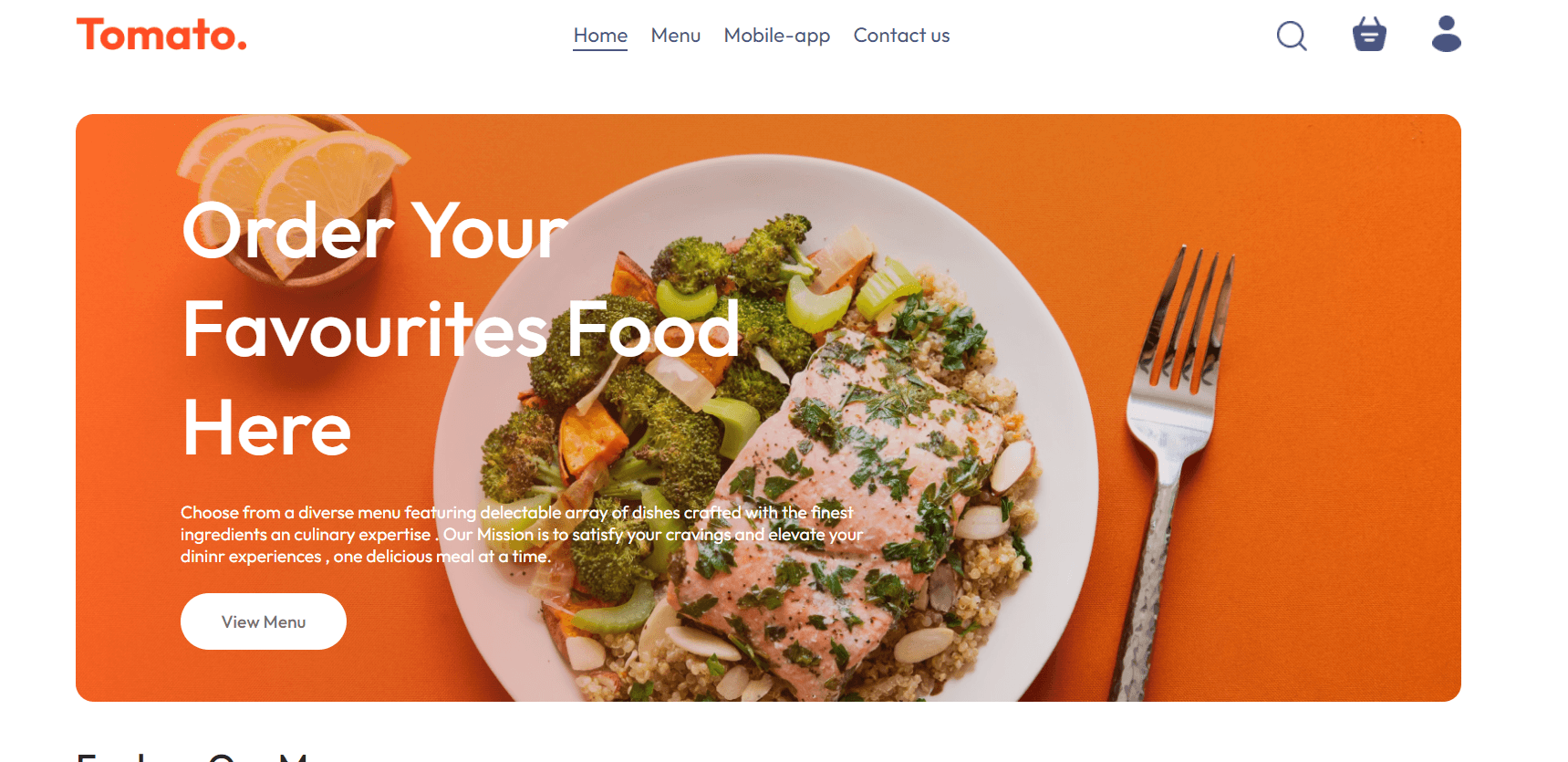
"Delivering more than just food — delivering a premium e-commerce experience."
Tomato is a full-stack food delivery platform designed to provide a seamless user experience for ordering food online. With an intuitive interface, real-time cart mechanics, and secure authentication, Tomato brings the convenience of a modern food delivery app directly to the web.
Problem Statement
"Ordering Food Should Be Effortless, Not Frustrating"
The food delivery market is massive, but many independent restaurants and small businesses struggle to set up their own platforms.
Users want a fast, reliable, and beautifully designed interface where they can browse menus, add items to their cart seamlessly, and complete transactions without friction.
The gap was clear:
Restaurants need a scalable digital storefront.
Customers need an intuitive and secure ordering experience.
The Challenge
- 🍔 Complex Cart State — Managing real-time cart updates across different components without slowing down the application.
- 💳 Secure Transactions — Processing payments safely while ensuring order accuracy.
- 🔐 User Authentication — Providing a secure login and registration flow for users to track orders and save addresses.
- 📱 Responsive Design — Ensuring the platform feels like a native mobile app even when used on a desktop browser.
The Solution
"Meet Tomato — A full-stack food delivery experience."
Tomato bridges the gap between hungry customers and great food by offering a complete, end-to-end e-commerce solution.
Browse → Select → Cart → Pay → Track
- Intuitive UI/UX — A clean, visually appealing frontend designed specifically for food lovers.
- Dynamic Cart Mechanics — Seamlessly add, remove, and update quantities with instant UI feedback.
- Secure Authentication — JWT-based authorization ensures user data and order history remain private.
- Payment Integration — Secure checkout flows to handle real-world transactions.
- Admin Dashboard — A dedicated space to manage food items, track orders, and oversee platform activity.
Tomato isn't just a menu — it's a complete restaurant e-commerce engine.
Technology Stack
"A modern MERN-based architecture"
Frontend:
React.js drives the interactive user experience, while modern CSS practices ensure a beautiful, responsive design that works flawlessly across all screen sizes.
Backend:
Node.js + Express.js powers the robust API, handling everything from user authentication to complex cart logic and order processing.
Database:
MongoDB serves as the flexible NoSQL database, efficiently storing user profiles, food catalogs, dynamic cart data, and order histories.
Payments:
Integrated with a secure payment gateway to process online transactions reliably and safely.
A scalable full-stack architecture built to handle the high demands of real-time e-commerce.
Deployment & Infrastructure
"From Localhost to the Web"
Frontend — Render
The user-facing application is deployed and optimized for fast loading speeds and high availability.
Backend — Render
The Node.js server and REST APIs are hosted on Render, providing a stable environment for processing orders and managing database connections.
A reliable deployment setup ensuring that Tomato is always ready to take orders.
The Tomato Story
"The realization that one project wasn't enough."
I had just passed out of college.
I opened my resume, looked at it, and realized a hard truth:
I only had one major project.
StudyNotion was great. It taught me the MERN stack. But in a highly competitive job market, having just one big project on your resume didn't feel like enough.
I needed something else. Something robust. Something that proved I didn't just build one app by accident, but that I actually understood how to engineer a full-stack platform.
So, I started searching for ideas.
🎬 CHAPTER 01 — THE YOUTUBE DISCOVERY
"From tutorial to true understanding."
I turned to YouTube looking for inspiration and discovered a tutorial for building a full-stack food delivery application.
A lot of developers fall into "tutorial hell"—just copying code without thinking. I had already learned that lesson the hard way with my first project.
This time, I made a promise to myself: I wasn't just going to copy the code. I was going to use it as a map to deeply understand the architecture.
I watched how the instructor structured the components. But when it came to implementation, I took the wheel. I wanted to understand exactly why state was managed a certain way, how the cart mechanics worked under the hood, and what made the payment integration secure.
Tomato wasn't just another project; it was my transition from a student following instructions to an engineer grasping the core mechanics of e-commerce.
🛒 CHAPTER 02 — THE CART CONUNDRUM
"State management is harder than it looks."
The core of any e-commerce application is the cart.
When a user clicks "Add to Cart", the number needs to update instantly. When they go to the checkout page, the total needs to calculate dynamically.
At first, passing this data between components was a nightmare.
Props drilling became too messy.
I had to deeply understand React state management to make the cart feel magical. When I finally got the cart to update instantly across the entire application without reloading the page... that was a massive win.
🔐 CHAPTER 03 — LOCKING THE DOORS
"Authentication and securing user data."
You can't have users ordering food without knowing who they are.
I implemented user authentication and authorization.
Hashing passwords. Managing JWT tokens. Protecting routes.
It was my first deep dive into real security practices. I learned how to ensure that User A couldn't see User B's order history, and how to keep sessions secure.
💳 CHAPTER 04 — SHOW ME THE MONEY
"Integrating real payments."
A store isn't a store if you can't buy anything.
Integrating the payment gateway was one of the most stressful but rewarding parts of the project.
Dealing with test keys, Webhooks, and order verification.
When the first successful test payment went through and the database updated the order status to "Paid", the application finally felt completely real.
🚀 CHAPTER 05 — THE FINAL BITE
"What Tomato taught me about e-commerce."
Building Tomato taught me that e-commerce is about trust.
If your cart is buggy, users lose trust. If your authentication is slow, users lose trust. If your payment flow is confusing, users leave.
Tomato pushed me to write cleaner code, manage complex states efficiently, and build a full-stack application that didn't just work—it felt professional.
The project that turned me into a full-stack e-commerce developer.